The Water Rises
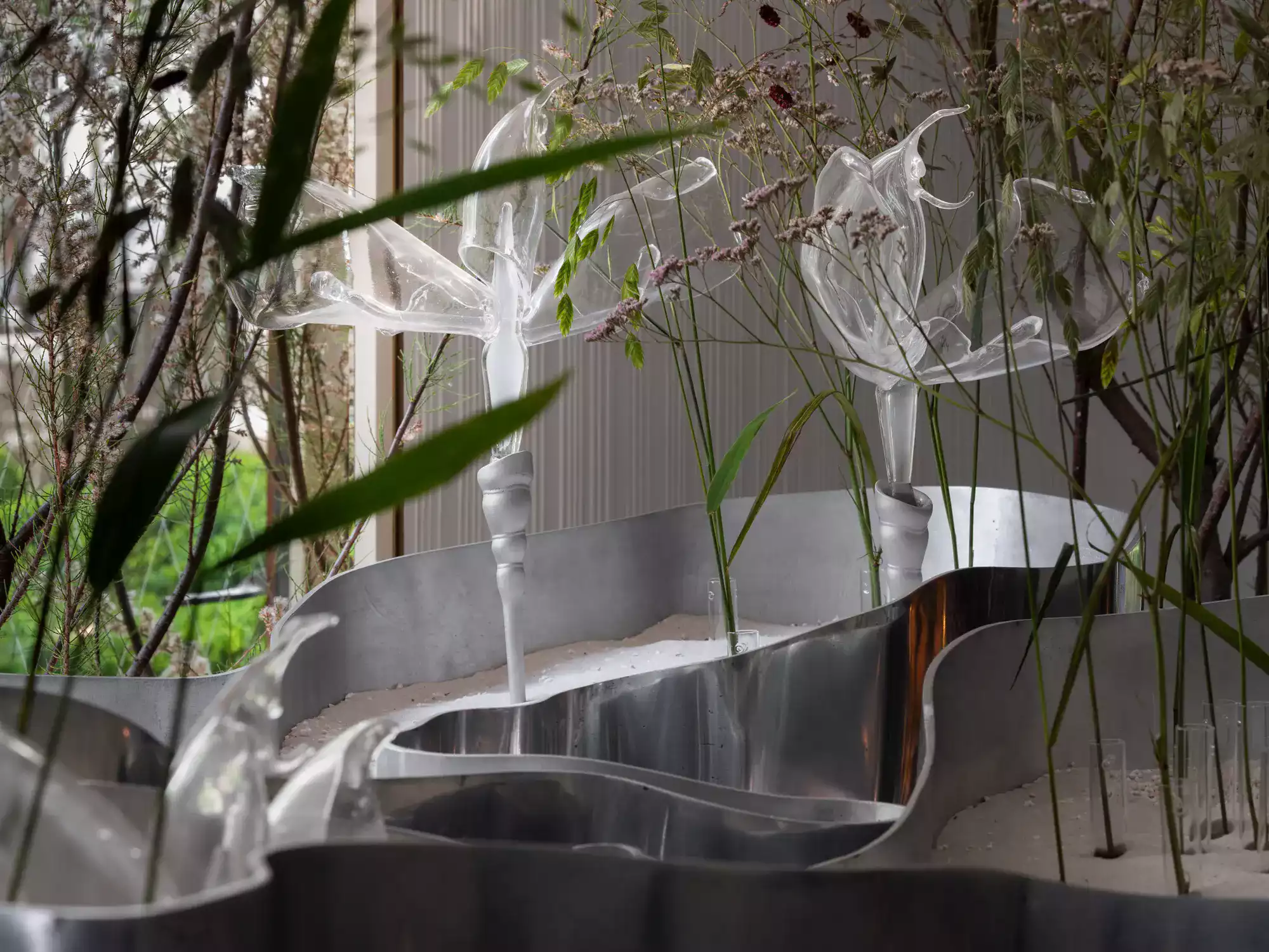
The Water Rises is a site-specific environmental installation conceived for Komorebi, curated by Marta Cereda and presented at The St. Regis Venice on the occasion of the opening of the 61st International Art Exhibition of the Venice Biennale. The project unfolds within the Long Gallery, a transitional space defined by natural light and its relationship with the canal, where architecture and the lagoon landscape overlap in a condition of perpetual threshold. The work originates from an investigation into phenomena related to the fragility and transformation of living matter: processes of erosion, dissolution, and the reconfiguration of natural identity. Within this framework, the research focuses on the barene of the Venetian Lagoon – unstable intertidal territories situated between land and water, emergence and submersion. Increasingly threatened by human activity, land subsidence, and rising sea levels, these ecosystems represent an extreme form of landscape in transition and, according to the most critical projections, may disappear by the end of the century. They are not simply places but conditions: shifting surfaces oscillating between visibility and invisibility, presence and disappearance. Within them emerges a submerged dimension in which matter never stabilizes but remains in a constant state of redefinition. It is through this logic that the installation develops as a perceptual environment rather than a narrative one, where the threshold does not coincide with a boundary but with an ongoing process of erosion and transformation.
The Water Rises places the viewer in relation to an evoked ecosystem, where fragility becomes a direct experience. The title refers to a dual movement: on the one hand, the actual rise of water levels as a consequence of climate change; on the other, the possibility of a transformation of living systems, a reconfiguration of forms of existence following the loss of equilibrium. In this sense, the project engages with contemporary reflections on the capacity of both nature and culture to generate new forms of organization from conditions of instability. The forms inhabiting the space appear as minimal, almost silent presences, suspended between recognizability and abstraction. Rather than constructing a linear narrative, they activate a series of perceptual traces: shifts in scale, material tensions, and surfaces seemingly deprived of a stable center. Water, light, and matter coexist as active forces within a dynamic state of continual oscillation. The forms emerge as bodies pushing outward from within, lacking defined contours and traversed by swellings, tensions, and openings. From this perspective, the very notion of landscape no longer appears as something external to the subject but rather as a shared condition of immersion. As Italian philosopher Italo Testa writes, “we have always been immersed in a shared environment… submerged within its horizon.”
Plume
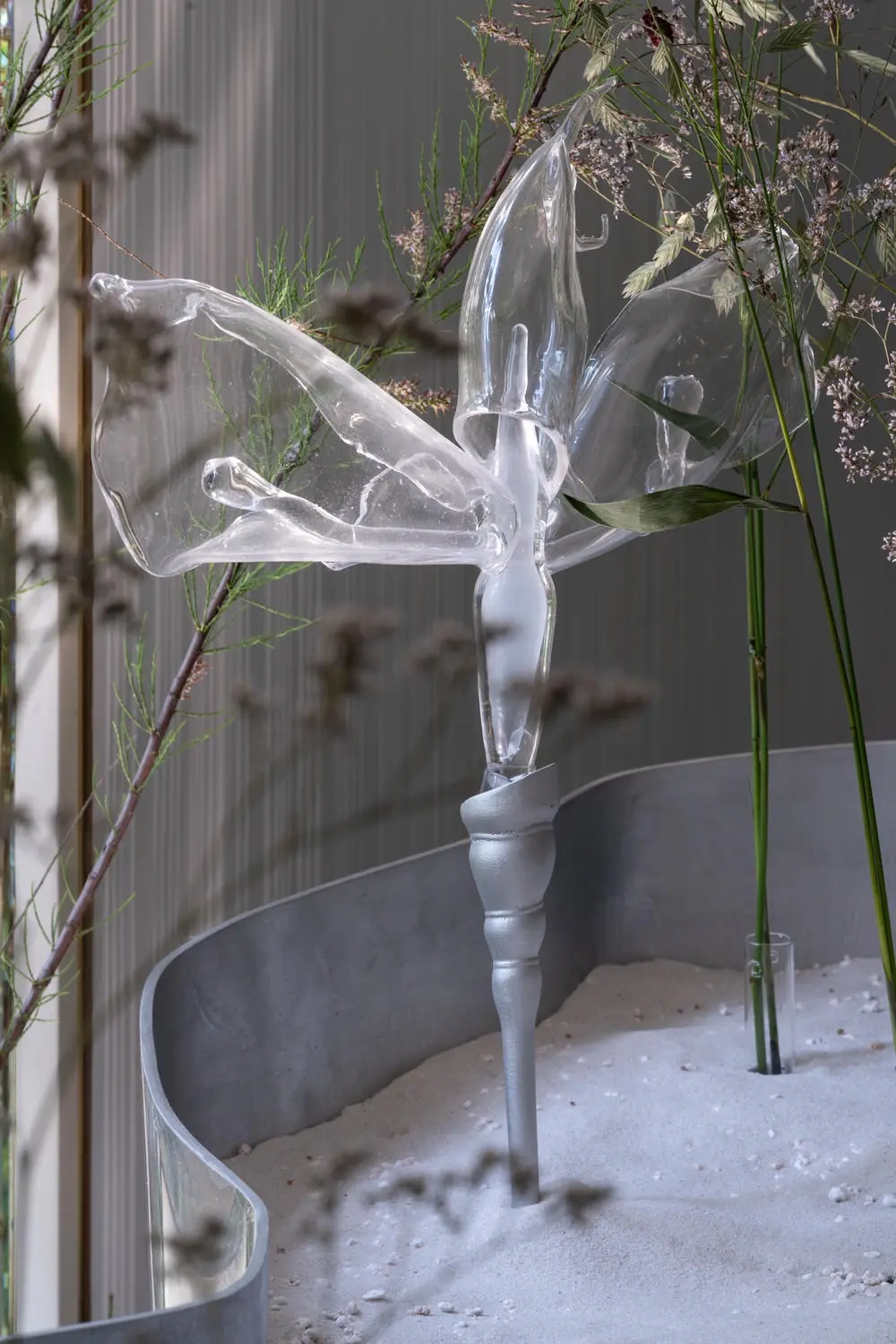
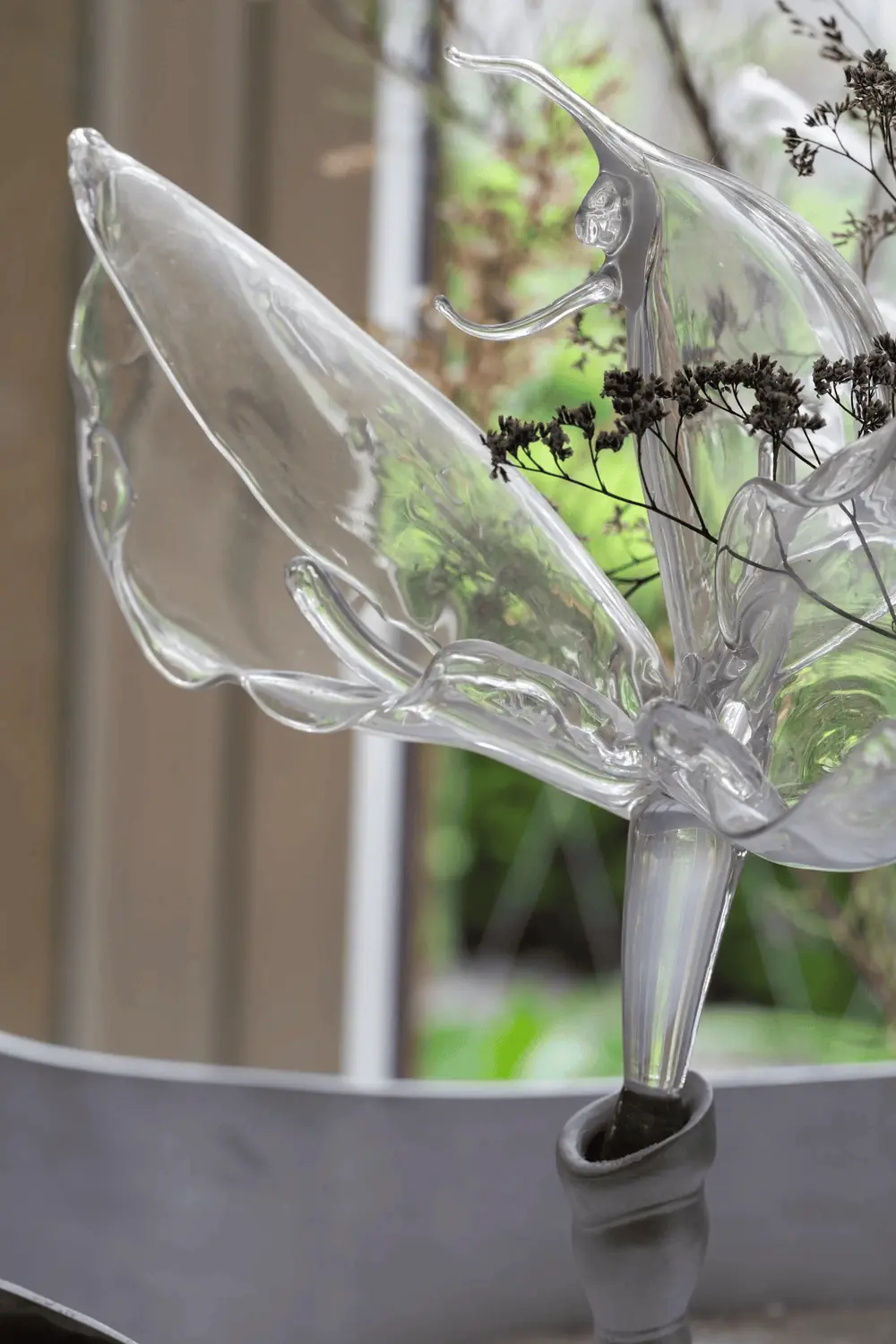
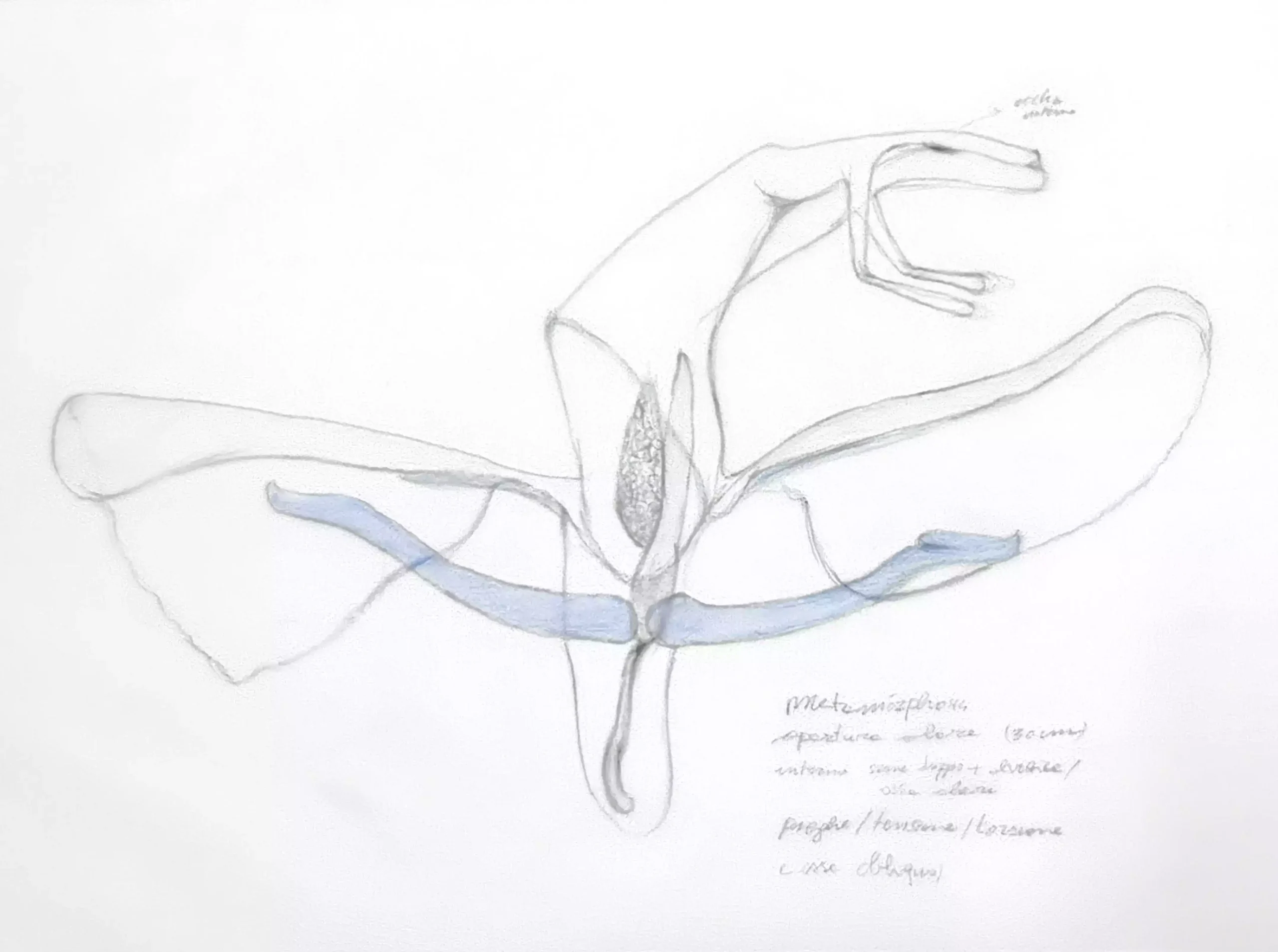
Plume I, II, III are sculptures in Murano glass produced at Berengo Studio. The forms originate from drawings developed through the observation of microscopic images of microorganisms inhabiting the barene of the Venetian Lagoon—extremely fragile ecosystems that host endemic species whose survival is closely tied to the preservation of these environments. The research focuses in particular on selected species of Lepidoptera: insects that remain relatively understudied and are especially vulnerable to the progressive degradation of their habitat. The potential disappearance of these ecosystems would entail not only a local biological loss but also the irreversible disappearance of forms of life and, with them, the possibility of future scientific inquiry. The investigation therefore turns toward microscopic identities, positioning itself within a threshold space between the visible and the invisible, between what can be observed and what escapes human perception. The title Plume refers to fragility as both a structural condition of existence and a formal principle of the work. Although the forms originate from real organic elements, they progressively depart from naturalistic representation to open onto hybrid and speculative configurations. The lines derive from microscopic imagery in which matter appears suspended between biological recognizability and abstraction. Within this process, the collaboration with the master glassmakers of Berengo Studio becomes essential: glass, through its fluid and unstable nature, allows the sculptures to maintain a constant tension between solidification and movement, control and contingency.
Matrice Ospite I, Matrice Ospite VI
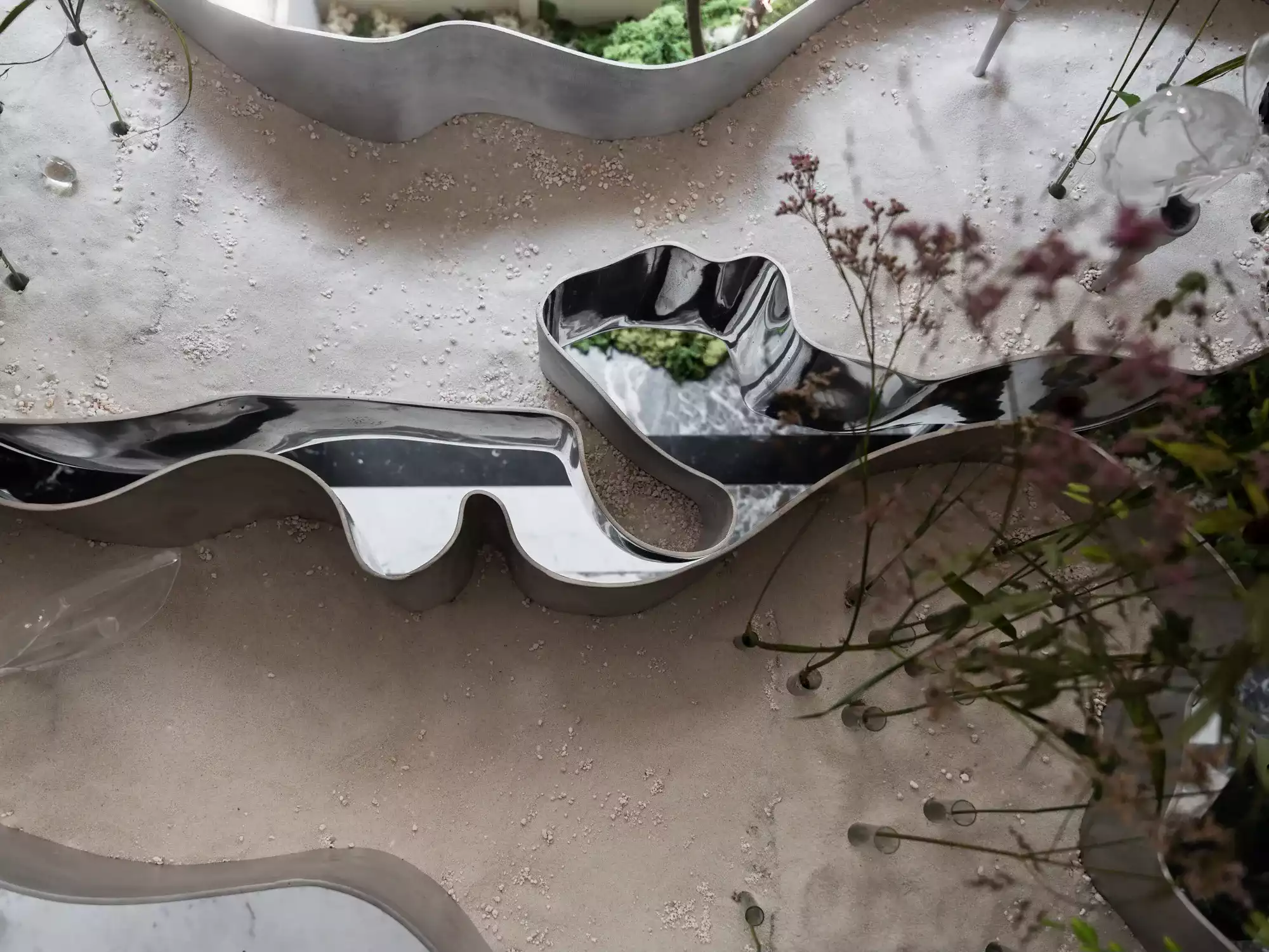
Aluminum castings based on the artist’s drawings, produced through the lost-wax casting process and finished with a mirror polish. The works incorporate vegetal, organic, and mineral elements, as well as the sculptures.
Plume I, II, III, unique Murano glass sculptures, blown and sculpted at Berengo Studio, 2026.